
Sedation
Sedation Explained – What to Expect
Save a copy or print this leaflet to read at home.
WHAT IS SEDATION?
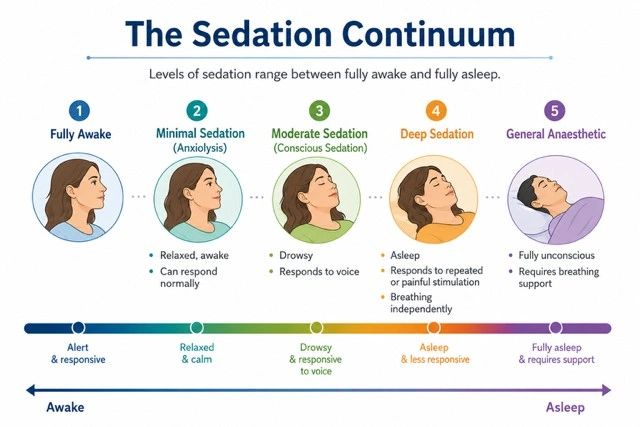
Sedation describes a continuum of consciousness, ranging from being fully awake and alert to being fully asleep under general anaesthesia.
It can range from light sedation which helps to reduce anxiety while you remain awake and able to breathe normally on your own, to deep sedation, where you are asleep and still able to breathe on your own but can still respond to certain stimulation. There are varying levels in between sometimes referred to as “twilight sedation”
HOW IS SEDATION GIVEN?
There are several ways to administer sedation, including;
- Oral medication, such as tablets or liquid
- Oral or nasal inspiration, such as gas or aerosol
- Intravenous (IV) sedation.
IV sedation can be administered either intermittently or by continuous infusion.
At Tauranga Oral and Maxillofacial Surgery, we most commonly use Target Controlled Infusion (TCI) – This is considered the ‘gold standard’ of sedation as it is tailored to each individual patient. The medication is delivered through a small IV line and carefully adjusted according to your individual characteristics, including your age, gender, height and weight. We also use a specialised monitor placed on your forehead, called a BIS monitor, which helps to assess your depth of sedation in real time.
This approach is both safe and effective. Our clinical staff are trained in TCI sedation, allowing us to carefully tailor and adjust the level of sedation to provide optimal comfort and safety.
The medications used during sedation provide:
- Analgesia - pain relief
- Euphoria – a feeling of wellbeing
- Anxiolysis – relief from anxiety
- Amnesia - reduced memory of the procedure
- Antiemetic effects – helping to prevent nausea and vomiting
WHAT SHOULD I EXPECT?
It is completely normal to feel nervous when you arrive. We will take you through the process step by step and make sure you are as comfortable as possible.
BEFORE YOUR PROCEDURE:
First, we will measure your height and weight and provide you with an anti-microbial mouthwash.
We will then insert a small IV cannula, usually in your right arm. If you have difficult veins or a preferred site for your IV, please let us know.
DURING SEDATION:
The sedation will start slowly and gradually be adjusted until you reach the level of sedation that is right for you.
Before you become too sleepy, we will place a plastic mouth prop between your teeth. This helps keep your mouth open whilst asleep. The mouth prop also reduces strain on your jaw joints and muscles. Please let us know if you have a history of TMJ problems, tooth clenching or grinding.
As sedation takes effect, you will gradually feel relaxed. It is best to close your eyes and take slow, deep breaths through your nose. We will often remind you to take deep breaths during the procedure and may gently tap you on the shoulder to encourage you to do so. This is completely normal and does not mean anything is wrong. Even while sedated, you can follow simple instructions
Throughout the procedure, we will continuously monitor your breathing, heart rate, blood pressure and level of sedation.
LOCAL ANAESTHETIC:
Once you are adequately sedated, we will administer local anaesthetic injections. This means you should not be aware of the unpleasant sensation associated with the injections. The local anaesthetic blocks pain signals, so although you may still feel pressure, movement or other sensations, you should not feel pain from the procedure. You will remain numb when you wake from sedation, and this numbness will usually last approximately 8-10 hours.
AFTER YOUR PROCEDURE:
Once the sedation is stopped, you will usually become awake and alert within a few minutes. You will then be able to walk to the recovery area, where you can rest comfortably in a recliner. We will let you relax for a short period before offering you a juice box and appropriate pain relief. We will go through your post-operative instructions with you and provide a post-operative prescription and any other relevant information.