Jaw Joint & TMD
Botox Therapy
Save a copy or print this leaflet to read at home.
WHAT IS IT
“Botox” is a medication that has been developed from a naturally occurring substance produced by the bacteria Clostridium Botulinum. It works at the neuromuscular junction and prevents muscles from contracting. Therefore it can be used to treat muscles that are overworking.
INDICATIONS
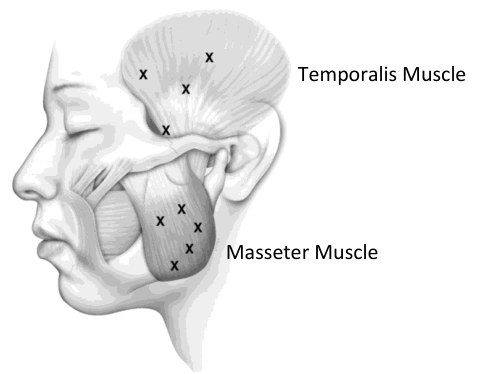
Botox is commonly known for its treatment of unwanted wrinkles; forehead, frown, crow’s feet. For patients that clench or grind their teeth and have TMD (Temporomandibular joint disorder) it can be used to treat the responsible muscles; masseter and temporalis.
If you have squaring of the jaw from overdevelopment of the masseter muscles the Botox will also help soften this.
Temporalis Muscle
Masseter Muscle
HOW IS IT DONE
Treatment is usually administered under intravenous sedation. Once you are in a state of sleep injections are administered to multiple sites within the muscle bulk of both the masseter and temporalis muscles. These are the main muscles which are involved in grinding and clenching. The pterygoid muscles are not treated to allow for enough jaw function for eating.
A dose of 100 units is administered.
OUTCOME
Immediately following the treatment you may have some pain in the area and will still have normal muscle function. You will start to notice a difference by day 3 with maximum effect at around 10-14 days.
EFFECT
The reduction in muscle function usually lasts 3-4 months. This return of function is starts with flickers of muscle contraction, and builds up over a period of weeks. Some patients do not require further treatments if the parafunctional bruxism (clenching and/or grinding) does not return with muscle function but treatment can be repeated as needed. Where multiple treatments are required the treatment interval can increase.
POSSIBLE COMPLICATIONS OF BOTOX
There are some inevitable consequences in this use of Botox. The face become slimmer as the masseter muscle shrinks. Chewing capacity is reduced and eating hard to chew foods such as crusty bread or steak will become tiresome. Both of these are temporary and return to normal with the return of normal muscle function.
Some side effects may also occur including more commonly some short term tenderness and bruising, headache, or inflammation. Less commonly there is risk of an allergic reaction or facial asymmetry. There is potential a small volume of the Botox could leach forward and effect the muscles around the mouth changing the appearance of a smile or other mouth movements. These are rare, generally mild, and temporary.
POST OPERATIVE INSTRUCTIONS
The following steps will help improve your recovery period
- REST – Rest for a few hours immediately following treatment and avoid strenuous exercise. You must not drive or operate heavy machinery for 24 hours following intravenous sedation.
- POSITION – DO NOT lie down, rub, or massage the treated area for the remainder of the day. This prevents displacement of the Botox.
- FOOD – AVOID hard to chew foods for the remainder of the day and AVOID alcohol for 24 hours.
- PAIN – Any pain or soreness can be relieved by taking a simple over the counter pain killers. Avoid using aspirin for 24 hours pre and post- surgery to minimise bruising.
A follow up appointment, if required, will be made on the day of surgery.
If concerning side effects or other symptoms occur during office hours contact the surgery without delay. 07 578 8847
Emergency contact numbers are as follows: John Bridgman (021) 767 421 Abi Estelle (021) 429 045 Nabeela Ahmed (029) 0203 4431 Brenton Wilson (020) 4134 3529