
Jaw Joint & TMD
TMD Patient Guide
Save a copy or print this leaflet to read at home.
General Overview
Temporomandibular disorders (TMD), also known as jaw joint disorders, are prevalent issues affecting up to one-third of the population. Most individuals experiencing these disorders can effectively manage their symptoms, including clicking, occasional pain, or mild restriction of jaw opening, without the need for interventional procedures. For those referred for consultation, management is typically conservative, often not necessitating surgery. Additionally, most individuals with TMD do not progress to develop arthritis.
Cause
The "normal" jaw joint is a ball and socket joint. It comprises the base of the skull (Temporal Bone), the lower jaw (Mandible), and a cartilage disc. Initially, the first two centimetres of jaw opening involve the rotation of the lower jaw against the cartilage disc. Subsequently, the mouth opens through the sliding motion of the lower jaw and disc along the base of the skull.
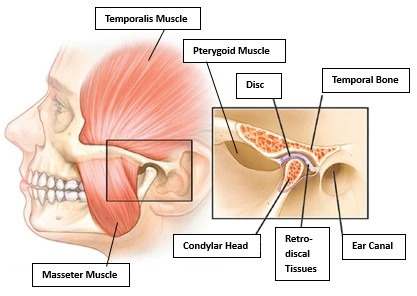
Approximately one-third of the population experiences a clicking sensation in the jaw joint. This occurs because the position of the disc is slightly forward to what is conventionally considered "normal," although this position can be regarded as a variant of normalcy. Typically, this displacement is a result of constant clenching, causing compression, thinning, stretching, and forward displacement of the disc. The initial phase of opening involves the lower jaw and the soft, sensitive tissues behind the disc, known as retro-discal tissues. Unlike the disc, these tissues are innervated and delicate. They normally adapt to the increased force exerted by jaw movements. As the jaw rotates, the disc clicks back into its more typical position relative to the lower jaw, completing the opening process and causing the audible click within the joint.
Occasionally, inflammation may arise in the retro-discal tissues due to injury or repetitive clenching, resulting in pain in and around the joint, akin to the sensation of spraining a joint. This discomfort may be perceived as emanating from the ear. When a joint is sprained, pain not only occurs within the joint but also in the surrounding muscles. This is because the body's response to injury involves contracting the muscles around the joint to stabilise it. Prolonged muscle contraction diminishes blood supply, leading to the accumulation of by-products of muscle contraction in the area, causing pain. This phenomenon is known as muscle spasm. Additionally, muscle spasm exacerbates joint inflammation, creating a vicious cycle of inflammation and muscle spasms.
Restricted jaw opening may result from muscle spasm, changes in joint lubrication due to inflammation, or the physical obstruction of further opening by the displaced disc failing to reduce with a click. This restriction can manifest as temporary locking or persistently limited movement.
Treatment goals aim to alleviate joint inflammation and reduce muscle spasm.
SIMPLE TREATMENTS
The optimal approach to managing a joint sprain is to rest it. However, resting your jaw can be challenging since you need to talk and eat. Therefore, it's advisable to avoid jaw exercises. Nonetheless, there are some straightforward measures that can help minimize strain on the joint as much as possible.
SOFTER DIET
Try to eat a softer diet and avoid food that are hard to chew. You should avoid sticky toffees and chewing gum as these increase the amount of chewing. Steaks and crusty bread are often difficult.
Muscle massage
Often, there are areas of tension in the muscles caused by muscle spasms, which may feel like rolling your finger over a "speed bump." These areas should be identified and massaged for one minute, four times a day. If you're in the correct spot, this massage should induce discomfort. It works by stretching the muscle, enhancing blood supply, and triggering your body to release its natural painkillers—endorphins—which help alleviate the pain. These muscles are located in front of, below, and above the ear. Typically, these measures alone are quite effective in reducing or even eliminating pain for the majority of patients.
Avoid wide mouth opening
Attempt to minimise opening your mouth wide. Cut apples into small pieces, avoid large sandwiches or burgers, and try to suppress yawning if possible. During dental treatment, opt for short visits or take frequent one-minute breaks throughout the procedure. However, it's important to note that you may still experience heightened discomfort afterward.
Topical Non-steroidal anti-inflammatories (NSAIDS)
Topically applied gels containing NSAIDs effectively reduce inflammation and alleviate pain in and around the joint. These gels have fewer systemic effects compared to oral tablets like Ibuprofen, yet they are equally effective. Examples of such gels include Ibuprofen, Diclofenac, and Piroxicam.
To use the gel, apply it regularly over the joint area four times a day for a duration of four weeks. The joint is located just in front of the small prominence in the middle of the front of your ear (Tragus). When you open your mouth, you'll notice a slight depression developing behind the joint. This is where the gel should be applied.

Bite-Splint A bite splint may be recommended to be worn exclusively at night. First, an impression of your teeth is taken, and then a splint is custom-made to fit over your teeth. Initially, some individuals may struggle to keep the splint in their mouth and may find that they have removed it by morning. However, it's important to persist with wearing the splint as it may take up to six weeks to begin showing some effectiveness. Approximately one in ten people are unable to tolerate it at all, as it may exacerbate clenching. When removed in the morning, your teeth may feel unusual, but this sensation usually subsides within a few minutes.
The splint functions in three primary ways:
- It distributes the load and diminishes the force transmitted to the joint.
- It increases the space between the teeth, allowing the muscles to stretch and reducing overnight muscle spasms and teeth clenching.
- By utilizing the lever and fulcrum principle, the force exerted by biting down on the teeth is redirected further toward the back of the mouth. Consequently, the load passing through the joint is reduced.
Conclusion
All these factors will be specifically discussed with you during your clinic appointment, but this summary serves as a helpful reminder of the main points. If the clicking in your jaw is your sole issue, it's of little concern, and you will be discharged. The treatment goals are to alleviate pain, improve restriction of opening, or resolve locking. You will undergo a review approximately six weeks after attempting these interventions to assess whether further treatment is necessary.